
A honeybee flying over yellow flowers on the Irish coast

Law · Land · Bees · Early Ireland

When a swarm crossed a boundary, the law followed.

A visual, sourced guide to Bechbretha—the remarkable early Irish judgments governing bees, honey, damage, ownership, and neighbourhood.

Twelve chapters · Glossary · Primary sources

A legal world shaped by movement

Bechbretha is the early Irish law-tract devoted to bees, swarms, honey, and the obligations that followed them.

The surviving text belongs to the learned legal tradition often called Brehon law. It does not read like a modern statute book: rules, glosses, examples, and later commentary accumulated around a compact core.

Bees mattered because honey and wax were valuable, portable products. The tract treats a colony as property while recognising that bees move freely across boundaries, making ownership inseparable from conduct, neighbourhood, and proof.
The complete guide

Read by question, not chronology.

Each chapter connects rules to the institutions and social relationships that made them work.

A transmission timeline

From legal school to printed page.

  1. 01 · 7th–8th c.

    The core bee judgments are associated with the early Irish learned legal tradition.

  2. 02 · Later Middle Ages

    Scribes copy, gloss, and interpret legal material in composite manuscripts.

  3. 03 · 1865–1901

    The Ancient Laws of Ireland series brings major legal texts into print.

  4. 04 · 1978 onward

    Critical editions and specialist studies enable closer linguistic and legal analysis.

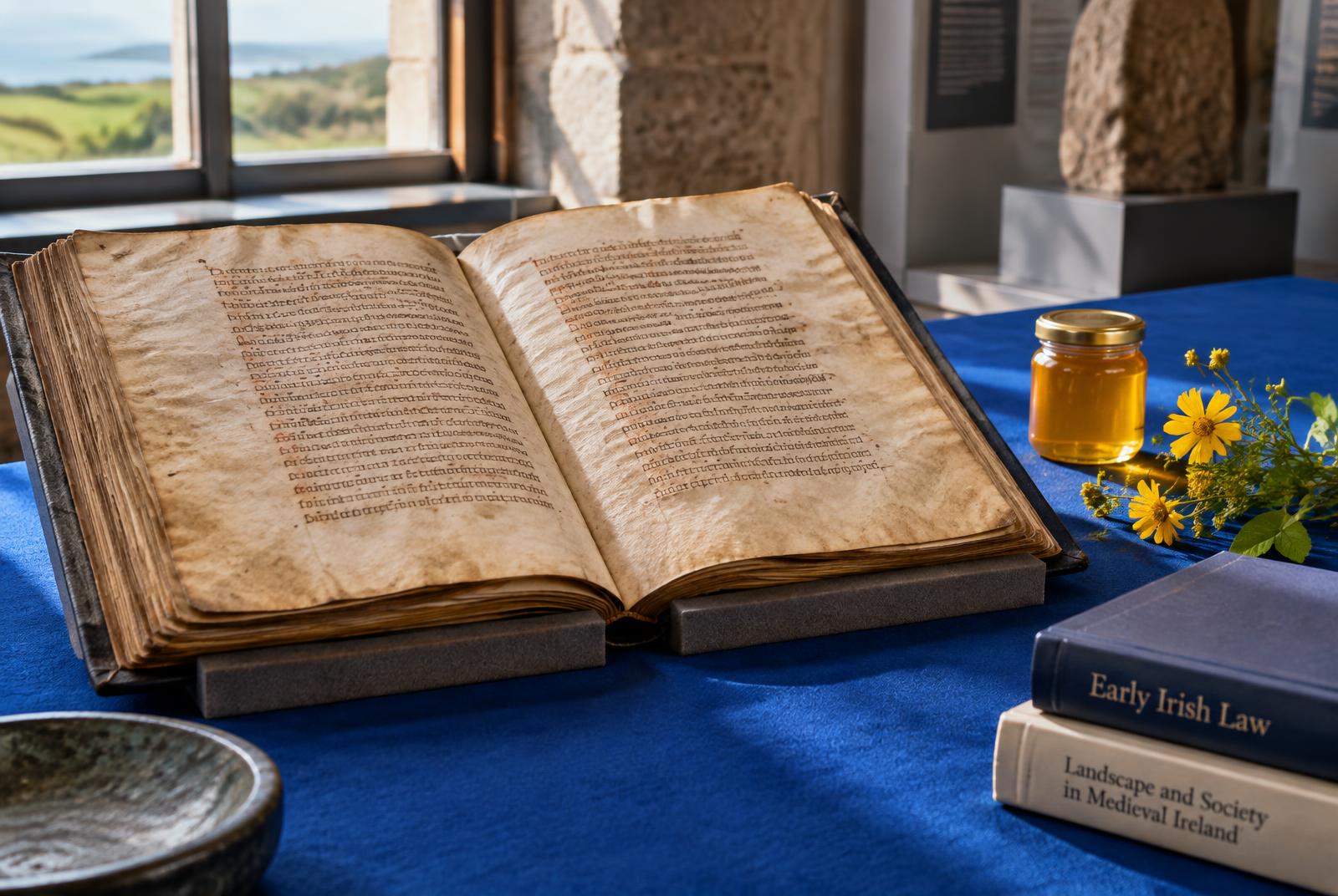
An open medieval manuscript beside honey and yellow flowers
“To understand a bee judgment, read the rule, the gloss, and the society around both.”A reading principle for this edition

Selected chapters

Concise introductions with source links. The surviving material is complex; these summaries avoid presenting disputed interpretations as settled fact.

02 · Law without a central state

Historical Context

Professional jurists preserved and interpreted a plural body of customary law in medieval Ireland.

A brithem, conventionally translated as brehon or judge, advised on legal classification, procedure, and the level of compensation due. Enforcement depended heavily on kin groups, sureties, pledges, and social pressure rather than a permanent state police force.

The bee tract should therefore be read as part of a larger legal ecology. Status, landholding, neighbourhood, and honour-price could shape the remedy even where the immediate dispute concerned a hive or swarm.

03 · Custody and care

Bee Ownership

Possession of a hive carried both a claim to its produce and duties toward people and property nearby.

The texts distinguish the managed hive from the wandering swarm. An owner’s claim was strengthened by visible care: maintaining the hive, marking it, observing its departure, and acting when it moved.

Negligence is not expressed through a single modern test. Instead, responsibility emerges from detailed situations—what the keeper knew, what could reasonably have been prevented, and whether customary precautions were taken.

04 · Flight and recovery

Swarms

Swarming created the tract’s hardest boundary question: when does a keeper’s bee become another person’s property?

Rules preserved in the bee judgments examine where a swarm settles, whether the original owner follows it, and what labour another person contributes to taking it. The legal result depends on facts in motion rather than a single abstract rule.

Rights of pursuit coexist with the landholder’s interests. Recovery could require notice, proof, or a division of value. Later glosses matter because they expose how jurists reasoned from terse rules to contested facts.

05 · Stings, trespass, and fault

Damage & Liability

Liability depended on preventability, warning, and the relationship between the keeper, injured party, and place.

Bee-related injury could affect people, livestock, crops, or another colony. The legal inquiry asks whether the bees behaved naturally and whether a keeper failed to take an expected precaution.

This is not strict liability in the modern sense. The tracts often classify incidents through fine factual distinctions. Translation and manuscript context must be checked before turning any isolated rule into a general proposition.

06 · Value, rank, and remedy

Compensation

Compensation was calibrated through the value of the loss and the social standing recognised by early Irish law.

Honour-price, or lóg n-enech, was a status-linked valuation used throughout the legal tradition. It could influence the seriousness of an offence, the weight of testimony, and the scale of a remedy.

Bee disputes also involved replacement, division of honey, and payments expressed through the economic units of the period. Modern summaries should resist converting every amount into a simple cash equivalent.

Try the honour-price calculator

07 · Produce and dues

Honey Rights

Honey and wax connected household production to hospitality, rent, tribute, and ecclesiastical life.

The right to take honey did not always map neatly onto ownership of land, tree, or swarm. The texts preserve layered claims that could recognise the keeper, the landholder, and those owed customary dues.

Honey appears in accounts of food, medicine, drink, and obligation; wax was indispensable for candles and specialist work. Their legal treatment reflects both everyday use and concentrated value.

08 · Proof and settlement

Dispute Resolution

Bee cases were resolved through learned classification, testimony, sureties, and negotiated enforcement.

A dispute might require proof of the hive’s origin, observation of a swarm’s path, or testimony about warnings and customary practice. Neighbours were not incidental: they could be witnesses, landholders, sureties, or interested parties.

The brehon’s role was to identify the applicable rule and lawful remedy. Compliance was supported by a network of guarantees and reputational consequences embedded in kinship and community.

09 · Case studies

How a judgment takes shape.

The legal tracts preserve rules and learned examples rather than modern case reports. These two reconstructions show the questions a jurist might need to classify; they are not claims about named historical litigants.

Reconstruction A · The pursued swarm

A marked colony settles beyond its owner’s land.

Relevant facts include whether the owner maintained pursuit, notified the landholder, and contributed labour to recovery. The remedy turns on the tract and its glosses, not merely on where the bees landed.

Reconstruction B · Injury near a hive

Livestock is harmed beside a managed apiary.

A jurist would distinguish natural bee behaviour from avoidable keeper conduct, then consider proof, warning, value of loss, and the status-sensitive rules of compensation.

Then and now

Similar questions. Different legal worlds.

QuestionEarly Irish approachCommon modern approach
Escaped swarmFact-specific pursuit, recovery, land, and labour claimsProperty rules vary by jurisdiction; capture and notice often matter
Keeper liabilityCustomary precautions and situational faultNegligence, nuisance, livestock, or local ordinances
Measure of remedyStatus, replacement, produce, and negotiated compensationProven loss, statutory fines, injunction, or insurance

Comparison is analytical, not legal advice. Contemporary rules differ between countries and local authorities.

Open the comparative timeline

11 · Glossary

Words that carry the law.

Bechbretha
Conventionally translated as ‘bee judgments’; the early Irish legal tract on bees and beekeeping.
Bech
A bee. Plural bechu / becha. The tract treats bees as productive livestock whose movements the owner cannot control.
Brehon / brithem
A professional jurist or judge trained in early Irish law.
Breth / bretha
A judgment or ruling; bretha is the plural, used in the titles of many law tracts.
Fénechas
The body of learned customary law associated with the early Irish legal tradition.
Féni
The free population of early Ireland whose customary law the tracts describe; ‘la Féniu’ means ‘among the Féni’.
Lóg n-enech
‘Price of the face’: a status-linked honour-price that sets the value of compensation owed for injury or insult.
Díre
A fixed penalty payment for injury or offence, calculated by reference to the victim's rank.
Cumal
A standard unit of value, originally a female slave, later reckoned in cattle; the common measure for fines.
Dílse
Lawful, unchallengeable ownership; property that has become ‘forfeit’ to its holder with no remaining claim.
Swarm / saithe
A colony in migration, central to rules of pursuit, recovery, and competing ownership claims.
Lias
A hive or shelter for bees; possession of the hive anchors the owner's claim to the colony.
Mil
Honey. The produce in which bee-trespass compensation is normally paid.
Comaithches
The law of neighbourhood: mutual obligations between adjoining landholders over fences, straying stock, and shared damage.
Comarsa
A neighbour. The four nearest neighbours are the class entitled to share in bee-trespass compensation.
Surety
A person or arrangement guaranteeing performance of a legal obligation.
Naidm
A binding surety who enforces an agreement, if necessary by distraint.
Ráth
A paying surety who covers the debt personally if the principal defaults.
Aitire
A hostage-surety who stands with their own body and liberty behind an agreement.
Athgabál
Distraint: the regulated seizure of goods, usually livestock, to force a defendant into the legal process.
Fiadnaise
Witness or testimony; fiadain are witnesses, whose presence validates acts such as pursuing a swarm.
Rann
A share or division; the mechanism by which competing claims to a swarm or to honey are settled.
Trespass forage
The grazing bees do on land their owner has no right to, which generates the neighbours' claim on honey.
Flaith
A lord or noble; status determines both honour-price and legal capacity.
Bóaire
A substantial commoner farmer, the benchmark free landholder in the law tracts.
Tellach
Formal legal entry onto land to assert a claim, performed in stages and before witnesses.
Gloss
A later explanatory note written between lines or in the margins of a law text, often centuries after the original.
Recension
A distinct version of a text as reworked by a compiler or school; the tracts survive in several.
Aire
A lord or noble, in multiple grades from aire déso up to aire forgill, each with its own honour price.
Ócaire
A small farmer of lower free status; the lowest of the commoner grades that still carried an honour price.
Éraic
‘Body fine’ or wergild: the fixed compensation for harm, scaled to severity and to the victim's rank.
Log nEnech
The ‘honour price fine’ paid on top of éraic, compensating the affront to the victim's standing rather than the injury itself.
Crólige
Sick maintenance: the ongoing cost of food, nursing and shelter the injurer bore during the victim's recovery.
Finntiu
Inherited kin-land, which remained subject to the kin group's claims and was difficult to alienate.
Troscad
Ritual fasting outside a debtor's home to shame them into settlement when other enforcement failed.
Cosmailius
Analogical reasoning: one of the five paths of judgment, and the route by which livestock law was extended to bees.
Fásach
An established legal maxim; the first of the five bases of judgment in Cóic Conara Fugill.
Aicned
Natural law: reasoning from the nature of a thing, including the nature of bees themselves.
Senchas Mór
The ‘Great Tradition’: the principal early Irish legal compilation, containing at least 47 tracts including the bee judgments.
Twelve doors of the soul
The vital faculties and orifices in Bretha Déin Chécht — eyes, ears, nose, mouth and others — whose injury attracted the highest compensation.
Mruigfer
A field worker; one of the commoner grades listed in the status tracts.
Ollam
The master poet, highest of the seven poetic grades, holding an honour price equal to the highest lay ranks.

12 · Primary sources

Start with the evidence.

Every citation in this resource links out to the evidence itself—the editions, transcriptions, and scans below. Follow them into critical scholarship before relying on a translated rule.

  1. 01

    Bechbretha: An Old Irish Law-Tract on Bee-Keeping

    Thomas Charles-Edwards & Fergus Kelly, eds., Bechbretha (Dublin Institute for Advanced Studies, Early Irish Law Series 1). The critical edition, translation, and commentary of the bee-tract itself.

    1983
  2. 02

    Senchas Mór

    The ‘Great Tradition’: the principal early Irish legal compilation, containing at least 47 separate tracts covering property, injury, fosterage, hostage, distress and specialised topics including bee-keeping. Printed with translation across the Ancient Laws of Ireland volumes.

    7th–8th c.
  3. 03

    Bretha Déin Chécht

    ‘Judgements of Dían Cécht’: the injury-compensation tract, with nine-day medical assessment, graduated wound measurement, physician's fees, sick maintenance, and the twelve doors of the soul. Edited by D. A. Binchy, Ériu 20 (1966).

    c. 8th c.
  4. 04

    Críth Gablach

    The status tract setting out the property qualifications of each social grade, from ócaire and bóaire to the noble aire grades. Edited by D. A. Binchy (Dublin Institute for Advanced Studies).

    c. 700
  5. 05

    Bretha Comaithchesa

    ‘Judgements of neighbourhood’: the law of adjoining landholders, fencing, straying stock and shared damage, from which much bee-trespass reasoning is drawn by analogy.

    c. 8th c.
  6. 06

    Berrad Airechta

    ‘Shearing of the court’: the tract on contract and suretyship, preserving the formulaic speeches used to appoint naidm, ráth and aitire sureties.

    c. 8th c.
  7. 07

    Cóic Conara Fugill

    ‘The five paths of judgment’: the procedural tract identifying fásach, cosmailius, aicned, samla and gnátha as the bases of legal reasoning.

    c. 8th c.
  8. 08

    Corpus Iuris Hibernici

    D. A. Binchy, ed., Corpus Iuris Hibernici, 6 vols (Dublin Institute for Advanced Studies). Transcription of the early Irish legal manuscripts.

    1978
  9. 09

    A Guide to Early Irish Law

    Fergus Kelly, A Guide to Early Irish Law (Dublin Institute for Advanced Studies, Early Irish Law Series 3).

    1988
  10. 10

    Early Irish Farming

    Fergus Kelly, Early Irish Farming (Dublin Institute for Advanced Studies, Early Irish Law Series 4). Bibliographic record lists manuscript witnesses.

    1997
  11. 11

    Early Christian Ireland

    T. M. Charles-Edwards, Early Christian Ireland (Cambridge University Press).

    2000
  12. 12

    Ancient Laws of Ireland

    Ancient Laws of Ireland, 6 vols (Dublin: Alexander Thom for HMSO). Public-domain nineteenth-century edition; use with modern critical scholarship.

    1865–1901
  13. 13

    Lex Salica (The Salic Law)

    The Salian Frankish code, including the tariffs for stolen hives. English translation via the Avalon Project, Yale Law School.

    c. 507–511
  14. 14

    Lex Baiuvariorum

    Ernst von Schwind, ed., Lex Baiwariorum (MGH LL nat. Germ. V 2, Hannover 1926). Digitised MGH edition.

    c. 740–750
  15. 15

    Bibliotheca legum regni Francorum

    University of Cologne database of the early medieval leges, with manuscripts, editions, and bibliography for the Visigothic, Lombard, Bavarian, and Frankish codes.

    ongoing
  16. 16

    Ancient Laws and Institutes of Ireland, Vol. 4

    The first printed ‘Bee-Judgments’ (AL iv. 162–204), with the editors' introduction on honey, wax, and the legend of Mo-Domnóc. Superseded by the 1983 critical edition but valuable for comparison.

    1879
  17. 17

    Irish Law Tracts Re-Edited: Coibnes Uisci Thairidne

    D. A. Binchy, Ériu 17 (1955), pp. 52–85. Re-edits the water-course tract that stands beside Bechbretha, and explains how bee-keeping and mills were both grafted on to the law of neighbourhood.

    1955
  18. 18

    Livestock in the Brehon Laws

    J. O'Loan, The Agricultural History Review 7:2 (1959), pp. 65–74. Animal values, the great milch cow at 24 screpals, and seizure limited to the value claimed.

    1959
  19. 19

    The Leading Principles of the Brehon Laws

    John A. Costello, Studies 2:8 (1913), pp. 415–440. Early statement of éraic as fixed body-price plus honour-price scaled by rank.

    1913
  20. 20

    The Ancient Brehon Laws of Ireland

    M. J. Gorman, University of Pennsylvania Law Review 61:4 (1913), pp. 217–233. Summarises the bee-tract for a legal readership, including stinging injuries and deaths.

    1913
  21. 21

    Irish Brehons and Their Laws

    Herbert Francis Hore, Ulster Journal of Archaeology, 1st ser. 5 (1857), pp. 36–52. Written while the official edition was still in preparation.

    1857
  22. 22

    Finn's Poem on May-Day

    Gerard Murphy, Ériu 17 (1955), pp. 86–99. A twelfth-century May-Day poem with bees at work; the notes use Bechbretha for the language of a swarm settling.

    1955
  23. 23

    Fosterage: Child-Rearing in Medieval Ireland

    Bronagh Ní Chonaill, History Ireland 5:1 (1997), pp. 28–31. The graded fosterage diet, with honey as the portion of royal children.

    1997